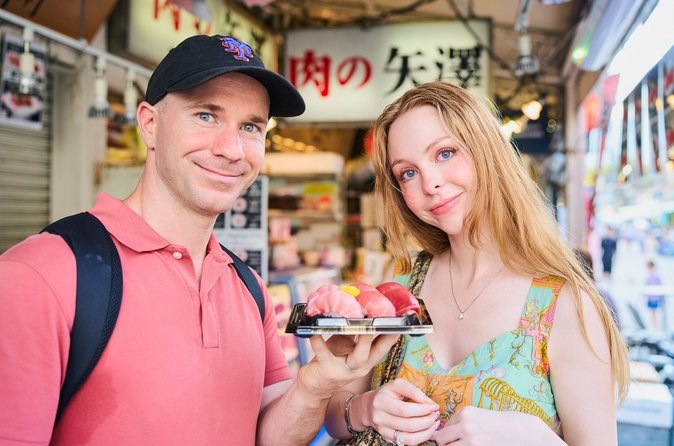
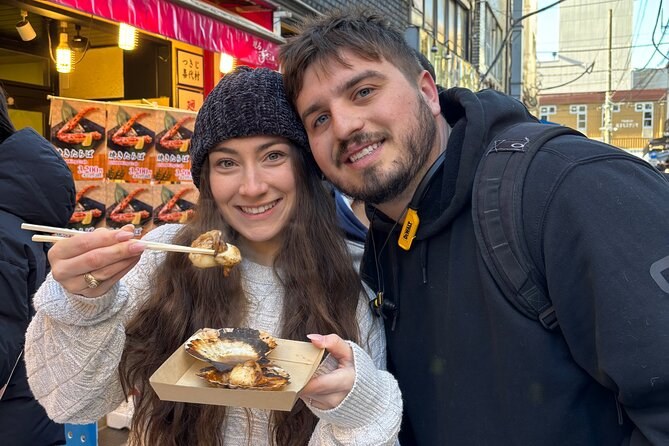
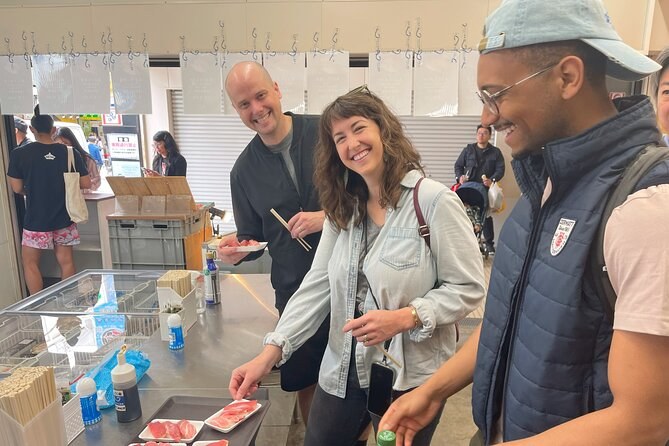
A market is a good day out with children for the same reason it is a good day out without them: things are happening at eye level, everything is edible, and nothing takes longer than four minutes. The complications here are narrowness, timing and stairs, and all three are solvable.
Is it actually suitable?
Yes. There is no admission to pay, no queue to hold anyone in, and the whole market is about ten minutes end to end, so a bad afternoon can be abandoned at any point. What it is not is a place to push a stroller through at half past eleven on a Saturday.
The stroller question
The lanes are three or four people wide with counters projecting into them and delivery carts coming through. Before nine it is a working market and a stroller is genuinely in the way; after eleven it is crowded enough that you will spend the morning apologising.
If you would rather keep it, several of the walks state stroller access explicitly, and one states step-free surfaces and transport throughout.
Which walks work with children, from their own listings
These are the captured fields rather than an opinion, and they differ more than you would expect.
What each walk's listing says about children
| Walk | Cap | Stroller | Worth knowing |
|---|---|---|---|
| Street food and culture walk, 90 minutes | 30 | Yes | The only one stating step-free surfaces AND infant seats. Ninety minutes suits short attention spans |
| Two-hour walk, buy your own food | 10 | Yes | Small group, and you choose every dish — useful with a fussy eater |
| Six-tastings small-group walk | 7 | Yes | Wheelchair-accessible surfaces and service animals allowed |
| Five-tastings three-hour walk | 20 | Yes | Groups run six to eight. Three hours is long for under-eights |
| Sushi class, 90 minutes | 20 | Yes | Classroom is up two flights of stairs, no lift. Teenagers love it |
| Market walk plus sushi class, 4 hours | 22 | Yes | Same stairs. Infants make sushi from a parent's kit rather than their own |
| Private food tour, 2.5 hours | Your party | Yes | Bends around a nap or a meltdown, which is what private buys here |
The stairs, and which two to avoid
Two of the sushi classes hold the class on the third floor of a traditional building with stairs only and no lift. Both listings say so plainly. With a toddler on your hip that is a real consideration; with a nine-year-old it is nothing at all.
The third class is at street level and states step-free access, and the sushi classes page sets the three side by side.
What children actually eat here
- Tamagoyaki. Sweet, warm, on a stick, 100 to 200 yen. The reliable one.
- Fruit. Strawberries in winter and spring, melon in summer, sold at proper fruit stalls.
- Fish cake and satsuma-age. Fried, savoury, nothing raw about it.
- Mochi and soft-serve. Every market morning should end on one.
- Grilled scallop. Cooked in front of them, which is half the appeal.
Raw fish is the gamble. Plenty of children take to salmon and to tamago nigiri and refuse everything else, which is fine, because the food post has eleven other things to point at.
Timing it
Nine in the morning. Everything is open, the trade has finished, and the lanes have room in them. By eleven you are queueing, and by one the stalls are closing. The calendar page also has the days it is shut, which matters more with children in tow than without.
Three things that make it easier
- Eat at the counter. The market asks you not to walk while eating, and a child with a skewer in a narrow lane is exactly the case the rule is for.
- Carry cash in small notes. Nothing here costs much and plenty of counters take no cards.
- Pick ninety minutes, not four hours. The market rewards a short visit and you can always stay on afterwards for nothing.
What about the tuna auction?
It is at Toyosu, it starts before dawn, and the one departure that reaches it is a private tour. One reviewer who did it with a young daughter says the private format is what made it work. Everyone else with children should read the auction page and then not do it.
Toilets, breaks and the boring practicalities
The most reliable toilets are at the Plat Tsukiji information centre and inside the Tsukiji Uogashi building, and there are more at Tsukiji Hongan-ji. Individual shops are small and mostly have none, so plan around those three.
Uogashi is also the answer to “where can we sit down”. Its third floor has a food court and a roof terrace, which is the only seating in the market that is not inside a restaurant, and it is a good place to let somebody finish a tantrum out of a narrow lane.
There is no cloakroom anywhere. Coin lockers at Tsukiji, Tsukijishijō and Higashi-ginza stations take a cabin bag between them, and getting here has which exit each one sits by.
What will actually go wrong, and what to do about it
Three things, in order of likelihood. Somebody will get bored in the first twenty minutes, which is why nine o'clock and ninety minutes beats eleven o'clock and three hours. Somebody will refuse the raw fish, which is why the tamagoyaki, the fruit and the fried fish cake exist. And somebody will want to touch something they should not, which is one of the market's own eight rules and the one children break first.
None of it is a disaster. The market is ten minutes end to end and you can leave at any point, having paid nothing to be there.
Making a morning of it
The market is about ten minutes end to end, which is not a whole morning with children unless you stop constantly. Two things sit close enough to extend it. Tsukiji Hongan-ji is free, open from six, and looks nothing like any other temple in Tokyo, which children notice. The Hamarikyu gardens are about ten minutes' walk south and have space to run in.
Higashi-ginza is three minutes the other way if what you actually need is a chair and a coffee. The map page puts all of it on the ground.
Allergies
Ask when you book, never on the day. The walks buy from kitchens they do not own and several say plainly that they cannot help; the classes are the flexible end. The allergy page has each operator's own wording and the Japanese phrases to show a counter.
Looking for the small-group ones? Tsukiji Fish Market Tours lists every walk with its cap, and a Tsukiji Fish Market private tour is the one that bends around a five-year-old.